On-page website optimization: content steps that help you optimize site for SEO
On-page SEO is like labeling the shelves in your store. When labels are clear, shoppers find what they need. Search engines work the same way. If you want to optimize site for seo, your pages need clear topics, helpful answers, and tidy structure. That is website optimization you can feel.
In the wider world of seo and website optimization, on-page work is the “front of the house.” It includes headings, titles, internal links, and content quality. It is also a big part of seo website optimisation for small businesses.
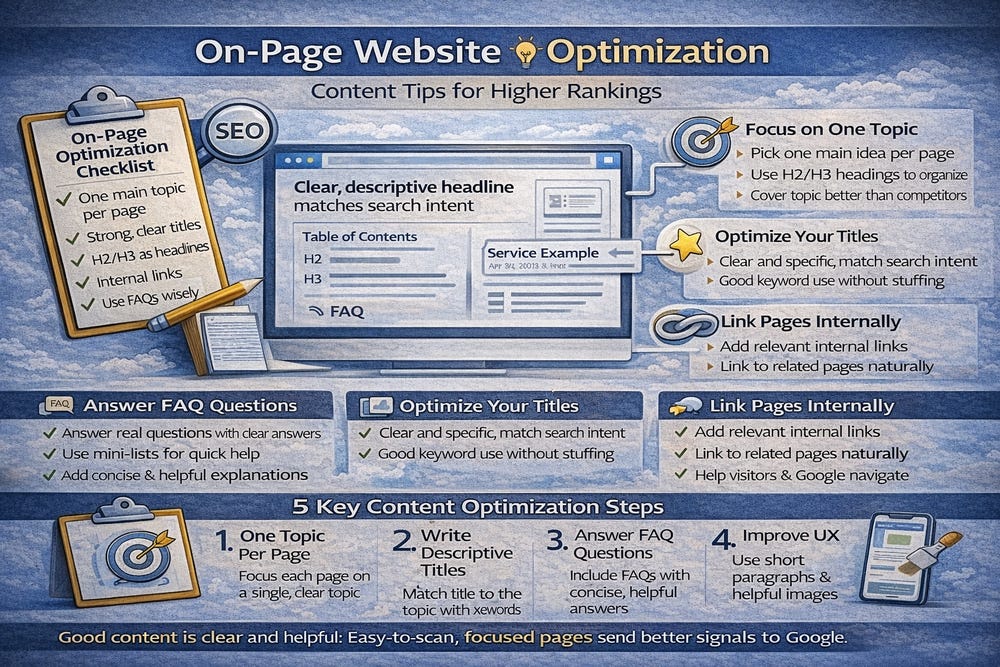
Website optimization fundamentals: pick one main topic per page
One page, one promise
If a page tries to rank for everything, it usually ranks for nothing. Choose one main idea, then support it with clear sections and examples.
Use headings like a table of contents
H2 headings are your big sections. H3 headings are your sub-steps. This is simple web optimization because it helps scan readers and helps Google understand the structure.
Optimize your website for SEO with better titles and snippets
Titles that match intent
Mailchimp’s checklist highlights title tags. A good title says what the page is about and what the visitor gets. Keep it specific.
Write for humans first
Google’s SEO Starter Guide talks about common improvements you can do. The safest “rule” is: answer the question better than anyone else, in plain language.
Internal linking: the quiet hero of an optimization website
Link pages like a helpful tour guide
When you link from one page to another, you are telling both users and search engines what matters. Link to your key service pages from your home page and your blog posts.
Build topic clusters
Create one main page (the “hub”) and several supporting pages (the “spokes”). This improves clarity and helps your website optimized structure grow over time.
Visual website optimization for content pages
Short paragraphs win
Keep paragraphs to 2 to 4 sentences. Use bullets. Add mini summaries. This makes your content more web optimized for busy readers.
Images should teach, not decorate
Use images that explain a step, show a result, or prove a point. Add alt text for accessibility and SEO. Keep files light for fast website optimization.
Website optimization analysis: what content should you update first?
Start with pages that already get impressions
If Search Console shows a page is appearing in search, you are close. Improve that page first: add missing sections, clarify headings, and include examples.
Composite win
A local legal services provider saw a 41% increase in organic calls after rewriting three service pages with clearer headings, adding FAQ sections, and improving internal links from their blog to service pages.
Content refresh: turn “old pages” into traffic again
Refresh beats replace
If a page already ranks a little, updating it is often faster than writing from scratch. Add missing sections, update examples, and improve the intro.
A simple refresh checklist
Rewrite the first 100 words for clarity.
Add one new section that answers a common question.
Improve internal links to and from the page.
Add one image with helpful alt text.
Check mobile layout and speed.
Website optimization analysis: where to get FAQ questions
Use real customer language
Write down questions you hear on calls and emails. Those are your best FAQ topics. People search those exact phrases.
Use “People also ask” carefully
Search your main service and look at common questions. Then answer them clearly on your page. This supports optimizing your website for seo without keyword stuffing.
How to write content that a 5th grader understands
Use simple words, then add one helpful example
Example: instead of “implement,” say “do.” Instead of “utilize,” say “use.” Then give an example that makes the idea real.
Use analogies that match your business
If you sell services, compare your website to a helpful receptionist. If you sell products, compare it to a neat shelf display. Analogies make website optimization less scary.
A 90 day content plan that supports SEO website optimisation
Month 1: fix and expand top pages
Improve the pages that already have impressions. Add FAQs and examples.
Month 2: publish 4 helpful posts
Each post answers one customer question and links to a service page.
Month 3: refresh and interlink
Update older posts, add internal links, and improve page titles for clarity.
A 90 minute website optimization sprint for on-page content
Step 1: pick one page that matters
Choose the page that brings money: your best service page, top product page, or the page people land on most from search. Improving one page is better than half-fixing ten pages.
Step 2: run a quick website optimization analysis
Check three things: traffic (are people arriving?), speed (does it load fast?), and action (do people click, buy, or call?). Write down one clear problem you can fix today.
Step 3: apply 3 quick fixes
Improve the title and first paragraph to match search intent.
Add one new section that answers a real customer question.
Add internal links to the most important service or product page.
Step 4: measure one simple result
After you ship the change, measure organic clicks to that page for the next 7 to 14 days. If it improves, keep the change. If it drops, roll it back and try a different fix. That is how website optimization stays practical.
Mini glossary: simple meanings for common terms
optimization meaning: making something work better for a real goal.
website optimization: improving your site so people find it and use it easily.
web optimization: the umbrella that includes speed, content, UX, and conversion fixes.
website optimized: a site that loads fast, feels clear, and drives actions.
visual website optimization: layout and design changes that guide the eye and reduce confusion.
fast website optimization: speed and stability improvements that reduce waiting and frustration.
FAQs
How many keywords should I use when optimizing your website for seo?
Focus on one main topic and a few related phrases. Use them naturally in the title, first paragraph, and headings. Do not force exact matches everywhere.
If the page reads smoothly, you are doing it right. If it sounds weird, you are trying too hard.
What makes content “website optimized” for beginners?
Clear language, short sections, and helpful examples. Explain any tricky word in one sentence. Use lists and steps. That way the page is useful even for a fourth grader.
Helpful content is also a strong SEO signal over time.
Do FAQs help SEO website optimisation?
Yes, when they answer real questions your customers ask. FAQs can add helpful context and make your page more complete. They also improve trust because visitors feel understood.
Keep answers short and focused. That makes them easy to read.
Conclusion
On-page work is the fastest way to make your site clearer. Pick one topic per page, write strong titles, use headings, and connect pages with internal links. Stack small updates and your site becomes more website optimized month by month.
If you want help planning and writing pages that rank and convert, our website optimization services for small business cover content strategy, on-page fixes, and ongoing improvements. Visit AGWebExp.